9 AI Tools for One Post? The New Reality of Blogging. Ai was going to make this a breeze and time saving but the reality is very different

Post by Peter Hanley Bizbitspro.com
You’ve been lied to. AI was supposed to be the “easy button” for content creation—the one-click miracle that would give us our weekends back and turn us all into effortless publishing moguls. Instead, as we kick off 2026, I found myself sitting in front of a high-tech digital assembly line, juggling nine different specialized platforms just to finish a single article. We aren’t writing less; we’ve simply become the managers of a complex robotic factory where “one-click” has turned into a nine-stage marathon.
The Digital Assembly Line
Just when I thought AI was making things easy, along came a bunch of “aids” to make it better. The irony? To stay competitive in today’s Google landscape, you can’t just “chat” a blog post into existence anymore. You have to orchestrate it.
Here is what my “simple” workflow looks like before I even type a single original thought:
- Step 1: The Foundation (Jaaxy) – I start here to check on traffic and competition. If the data doesn’t back the keyword, the post is dead on arrival.
- Step 2: The Hook (Headline Studio) – Even with a great keyword, I need a click-worthy title. I run my ideas through the analyzer and tweak until the score hits the “green zone.”
- Step 3: The Brain (Gemini) – This is where the heavy lifting happens. Because I’ve saved my personal brand details and style guides, I can feed Gemini specific instructions to draft content that actually sounds like me.
- Step 4: The Visual (Nano Banana) – Google is visual-heavy now. I head to my image maker to create a high-fidelity hero image that matches my headline perfectly.
- Step 5: The “Google Love” (Napkin.ai) – We know Google loves data visualization. I use Napkin to knock out a graphical layout so the “bots” see structured, helpful data.
- Step 6: The Reality Check (Monosnap) – To give the post “life,” I use Monosnap to capture real-world screenshots that prove what I’m talking about.
- Step 7: The Branding (Wealthy Affiliate Logo Tool) – To ensure I’m not just another anonymous AI site, I add my custom logo built right inside Wealthy Affiliate to maintain my authority.
- Step 8: The Payload (The CTA) – I grab my link for a paying product. Without a clear Call to Action, a blog is just a diary entry.
- Step 9: The Post-Game (Analytics) – Finally, I save every detail to a tracking file so I can use analytics to see if all this work actually moved the needle.
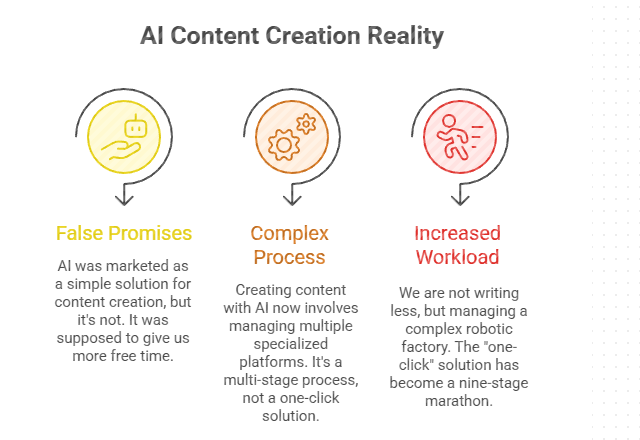
Nine Tools… and Still No Human?
At this stage, I have a completed document and a beautiful layout, but I haven’t written a single word of the “final” draft yet. This is where the most important tool comes in: The Human Brain. All these tools do is build the car. I still have to drive it. I have to read through, add my personal anecdotes, fact-check the AI’s enthusiasm, and ensure the “soul” of the piece is intact.
The “Easy Button” was a myth, but the “Power Button” is very real. We have more power to rank and earn than ever before—it just requires a bigger toolbox than we expected.
Stop Jugging Tools and Start Building a Business

If managing nine different tabs feels like a full-time job, you need a hub that brings the chaos together. Most of the tools I mentioned above—from the high-level keyword research of Jaaxy to the professional Logo & Article Designers—are integrated directly into the Wealthy Affiliate ecosystem.
Don’t just collect tools; build a system that works for you.
Ready to streamline your AI workflow? Join Wealthy Affiliate today and get the training and tools you need to turn your content into a real business.

More reading;why using AI gives you a better chance of success